
“We are sailors who also happen to run a charter business. The difference shows up in the details — in the digital anchorage video guide that tells you exactly where the sandbar is, not just that one exists. In the weather briefing that explains what a northeast wind actually does to the swell in the channel between Koh Mak and Koh Kood. In the provisioning list that knows the ferry schedule and which villages have cold beer.”
Your charter, step by step — from confirmation to check-out.
-
Once your booking is confirmed, you'll receive an invitation link by email — and from that point, we only need two things from you: an email address and a phone number. Everything else happens through the AQUA Charter App(available as a web portal or mobile app, no separate download required).
Inside the app, before you even leave home, you can:
Sign the charter contract electronically — no printer, no scanner, no PDF attachments
Submit crew details and passport information — directly in the app, securely stored
Order extras — SUP board, outboard dinghy motor, Wi-Fi router, early check-in, provisioning packages and more
Read the yacht manual — full equipment guide, onboard systems, emergency procedures
Review your check-in instructions — so day one has no surprises
Message our base team directly — questions before departure answered by the people who will meet you at the pontoon
By the time you land in Thailand, the paperwork is done. The contract is signed. The crew list is filed. We know what extras you need. You know where everything is on the boat.
-
When you arrive at the base, the check-in procedure starts immediately — no waiting for a base manager to become free, no queue at the desk.
Open the app and work through the inventory checklist at your own pace. For each item — navigation instruments, safety equipment, sails, engine, galley, heads — you'll see video guides and photo references showing exactly what you're looking at and how it works. For each item you mark Accepted or Issue. If something is missing, not working, or unclear, flag it in the app. It takes a note and a photo, and the notification reaches our base team instantly.
Once you've completed the checklist, we receive your full signed inventory automatically. If there are any flagged items, a base manager joins you at that point — not at the beginning to walk you through everything you already know, but precisely where you actually need them. Issues get resolved. Questions get answered. Then you go sailing.
On return, the check-out works the same way: digital checklist, photos, instant record. Both parties have a timestamped, signed document. No disputes, no ambiguity.
Once all checklist items are cleared You will be required to sign your credit card release for the security deposit (or leave cash). If you have used the AQUA Charters provisioning service, you'll need to pay for the provisions and any other extras you've ordered for your trip.
Payment can be done in local currency, EUR,USD or by credit card with 3 percent surcharge for credit card payments.
-
Here is a scenario we see every season: a crew flies in from Europe or elsewhere, lands in Bangkok, transfers to Trat or takes the ferry, arrives at the base in the afternoon with bags, groceries, questions and jetlag. They check in, they go through the boat, they want to get going. So they motor out at 5pm into an unfamiliar channel, in fading light, on a boat they've had for three hours, looking for an anchorage they haven't visited before. It rarely ends badly. But it rarely ends well either.
The nearest anchorage from our base is at least an hour away under engine. By the time you're there it's dark, you're anchoring for the first time on this particular boat, dinner is whatever is easiest, and the start of your sailing holiday feels more like the end of a long journey — because it is. There is a better way.
Stay the First Night. It's Free. It's Calm. It Sets Everything Up.
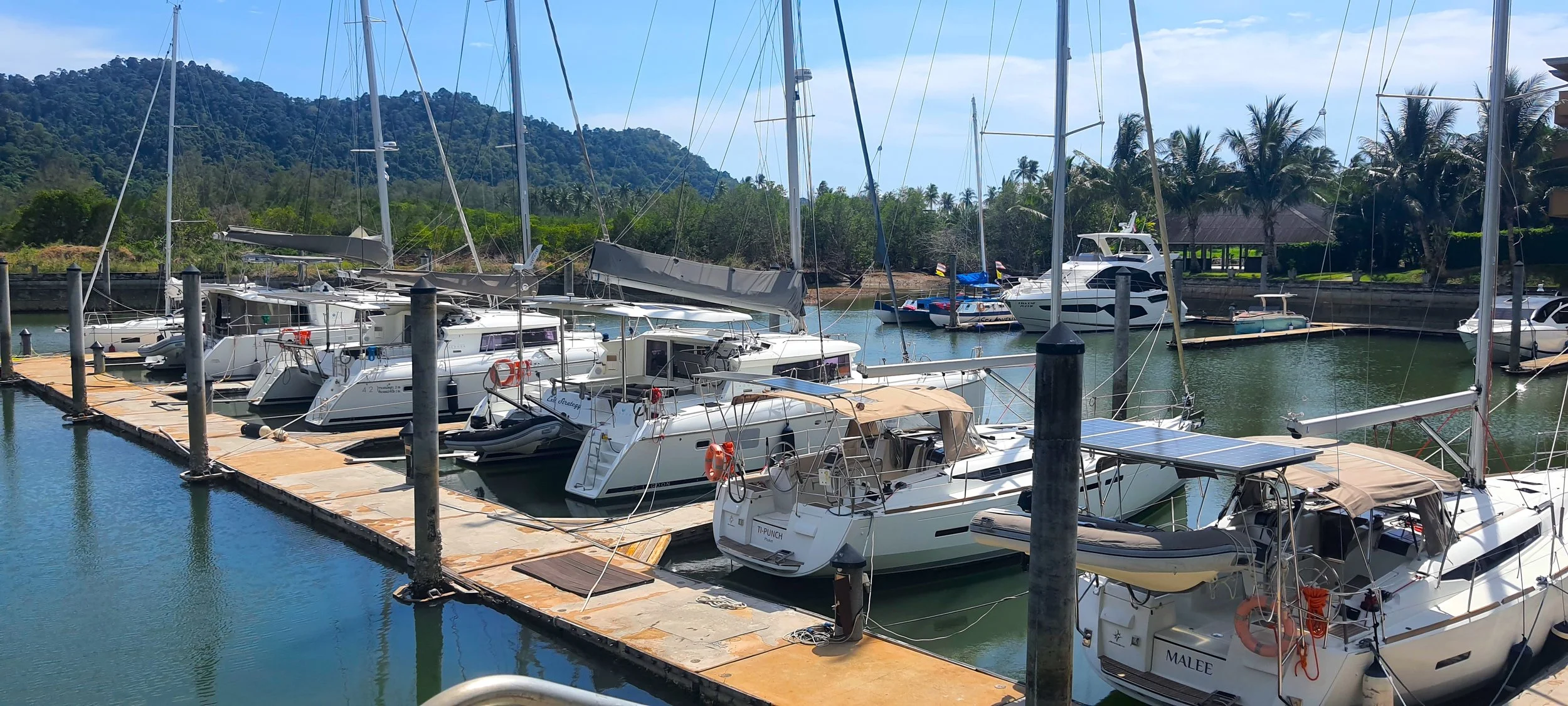
We offer every crew the option to spend the first night on a marina berth or on our bay moorings — at no extra charge. It is not a formality. It is genuinely the best way to begin.
Here's what the evening looks like instead:
You've checked in. The boat is yours. The sun is still up and there is no pressure to be anywhere. Take an hour to move through the boat at your own pace — find where everything lives, run the engine, figure out the heads, open a beer in the cockpit and just be on the water. Not going anywhere. Just being there.
Our base is set within a gated marina community — quiet, secure, with the particular calm that comes from being somewhere that takes care of itself. Your boat, your gear, your peace of mind — all looked after overnight without a second thought.
When you're ready for dinner, walk off the pontoon. The restaurant is right on the shore — proper food, cold drinks, tables that look out over the water. Not a tourist trap, not a shack. A place where you can sit, exhale, and finally feel like the holiday has started.
After dinner, if you feel like it, the bar and swimming pool are there — same shoreline, same easy walk from the boat. A swim, a Singha, the sound of the water.
If someone in the crew arrived with a long-haul back or a neck that spent ten hours in an economy seat, there is a massage studio right here on the marina grounds. Not a fifteen-minute tuk-tuk ride into town — right here, on site. Book a Thai massage before dinner or after. The evening is yours to design.
Getting around the complex couldn't be easier either: the marina runs complimentary golf cart transfers across the grounds, so nobody has to haul bags or walk distances after a long travel day. It is a small thing. After fourteen hours in transit it is exactly the right small thing.
By ten o'clock most crews are the most relaxed they've been in weeks. The kind of relaxed that only happens when the logistics are done, the boat is sorted, and tomorrow is already taken care of.
You sleep aboard your own yacht. Not in a hotel room, not in transit. In the berth that will be home for the next week. The boat settles around you. You learn its sounds.
-
First thing in the morning, one of our base team pilots you out of the marina. This is not a formality either — the channel has its character, and leaving with someone who knows it means you start the passage confident, not cautious.
By the time you clear the channel, the crew is awake, fed and alert. The boat feels familiar. The first anchorage is an hour ahead in good light, and you know exactly what you're doing when you get there.
That is how a sailing holiday should begin.
-
Before we get to the return, it's worth understanding how the Charter App works throughout the week — not just at the beginning and end.
The app is your direct line to the base team for the entire duration of your charter. If something on the boat needs attention — a question about a system, a minor issue with an instrument, anything that doesn't feel right — you report it through the app chat. The message goes to our technical team immediately, with a timestamp and whatever photos or details you add.
From our side, that report is logged as a maintenance task and assigned to the right person. It gets tracked, responded to and closed in the system — not lost in a WhatsApp thread, not forgotten in a phone call that nobody wrote down. If the issue needs resolution when you return to base, the work order is already prepared before you arrive. If it can be resolved remotely with guidance, we do that in the chat.
Every open and closed item stays in the maintenance record. At the end of the charter, both sides have a complete, accurate picture of how the boat performed during the week. No disagreements, no selective memory, no ambiguity about what was flagged and when.
This is not just convenient for you. It is how we keep our fleet genuinely well maintained — because every reported issue, however minor, feeds directly into the service schedule for that boat.
-
The last morning of a sailing holiday has a particular feeling. The anchorage you've woken up in all week. The crew that started as passengers and ended as sailors. The quiet before the engine goes on for the last time. We try not to ruin it.
Check-Out Through the App — Clean, Fast, Fair
When you are ready to hand the yacht back — bags off, crew ashore, boat tidied — you press a single button in the app: Ready for check-out.
That signal tells our dock team that the yacht is clear and the check-out inspection can begin. A crew member goes through the boat systematically against the same inventory checklist you completed at departure — every item, every locker, every piece of safety equipment. This takes around twenty minutes. The completed check-out record, with photos and timestamps, lands in the system and is shared with you automatically. You have it on your phone before anyone has said a word.
Our Charter Coordinator will meet you at the dock for a brief debrief — typically 10 minutes. This is not an interrogation and it is not a bill-finding exercise. It is a conversation: how was the week, what worked well, what could be better, any items to note from the checklist. Because the check-in record, the in-charter maintenance log and the check-out inspection are all in the same system, with timestamps and photos, there is a complete documented history of the boat throughout your charter. If a question arises about any item — condition at departure, issues during the week, condition on return — the answer is in the record. Clear for both sides.
The dockside crew refuels the yacht while this is happening. Fuel used during your charter is settled at this point — cash or card, your choice.
And then you are done. The yacht is handed back. The holiday is complete.
Nobody Is Going Anywhere
Here is something we mean genuinely: there is no rush to leave the base.
Check-out done, bags off the boat — and then what? Your flight might not be until evening. The transfer might be hours away. At most marinas, this is where the holiday ends awkwardly: you're sitting on a wall with your luggage, the boat is already being cleaned, and you're neither here nor there.
At our base it works differently.
Leave your bags with us — we'll look after them properly, not stack them in a corridor. Then go back to the pool. Have lunch at the restaurant. Get a massage. Catch the golf cart to the far end of the grounds and find a chair in the shade. There is no signal that it's time to go until your transfer actually arrives.
-
Our base office is not a place you visit to sign things and leave. It is the kind of room that sailors end up staying in longer than they planned.
Cold drinks. Comfortable seats. Sailing charts, books and cruising guides on the shelves if you want to plan the next trip while the memory of this one is still fresh. A team who know these waters and are genuinely happy to talk — about what you saw, about where you should go next time, about what the Koh Kood is like in February.
If you want to book the next charter before you leave the island, we can do that here. If you just want to sit for a while, that works too.
The transfer will come. Until it does, consider the base yours.
Sailing Season in the Gulf of Thailand
The official sailing season in our part of Thailand runs from October to April, driven by the northeast monsoon. What the brochures don't say is that the season has a personality — and it changes month by month in ways that matter for passage planning.
October and November bring the most reliable wind: 15–25 knots from the northeast, building seas on the windward side of the islands, glassy water in the lee. December through February is the sweet spot — consistent 10–18 knots, settled weather, warm nights, excellent visibility. March starts to see the wind die back, April can be frustratingly light.
The southwest monsoon (May through September) is where the story gets interesting — and where our two bases make a difference that no other charter company in the region can offer.
When the southwest monsoon arrives, the Gulf of Thailand splits in two. Koh Chang and the eastern gulf go into their quiet season — manageable, but wetter and windier from the south. Koh Samui, on the other side of the Thai peninsula, does the opposite: it enters its best sailing window. The southwest monsoon that batters Phuket and the Andaman Sea is blocked by the Nakhon Si Thammarat mountain range running down the spine of the peninsula. The result is that Koh Samui and the Samui Archipelago — Koh Phangan, Koh Tao, Ang Thong Marine Park — enjoy settled skies, warm consistent wind and calm seas from May through September, precisely when every other sailing destination in the region is shutting down.
This is not a loophole or a lucky accident of geography. It is the reason we opened our second base at Koh Samui. If you want to sail Thailand in June, July or August — and sail in proper conditions, not in spite of the weather — Samui is the only answer in this part of the world. Many of our clients now plan their trip specifically around this: Koh Chang in January, Koh Samui in July, same boats, same team, entirely different world.
Supplemental documents
Sample itineraries Koh Chang
Base Information and FAQ